

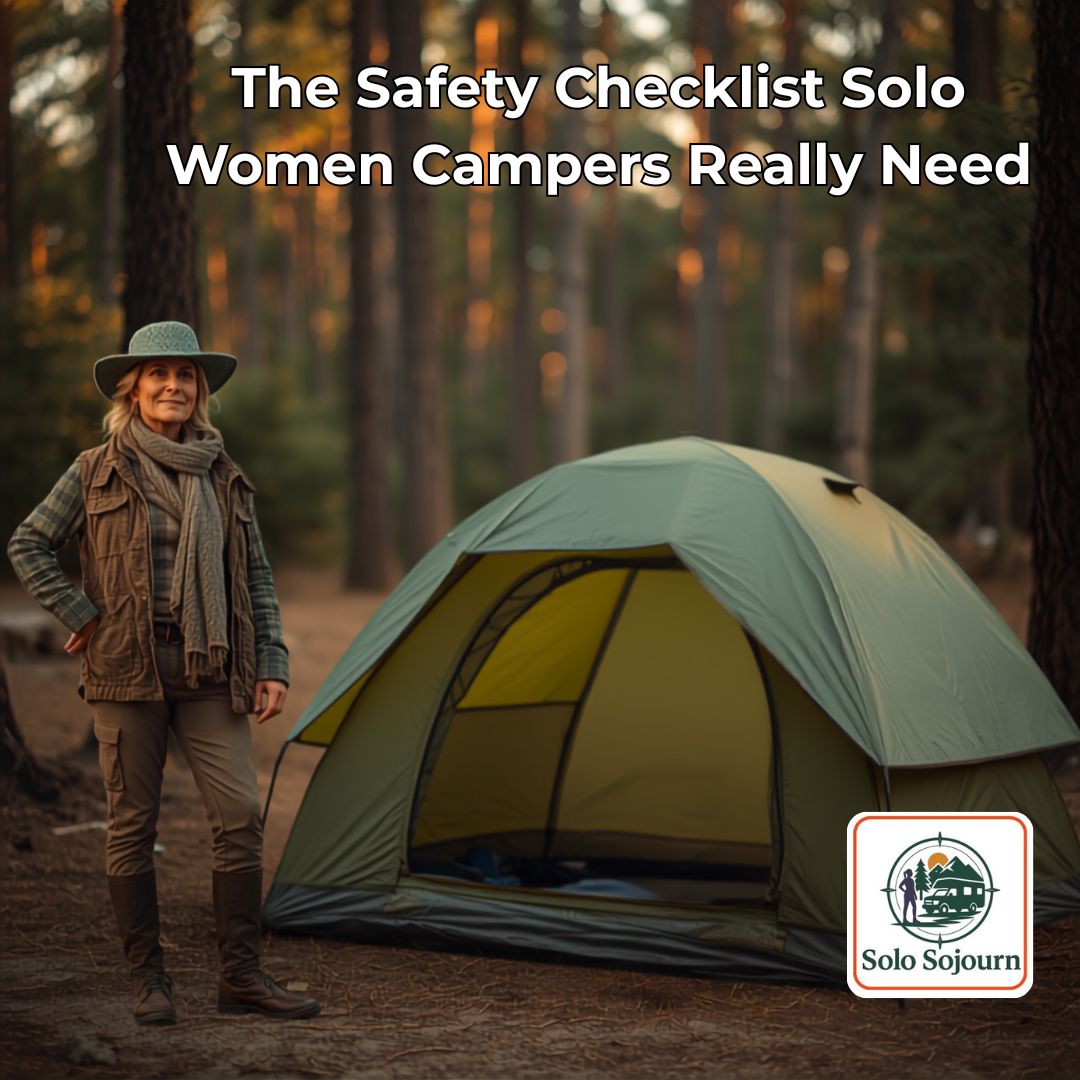
I’ve set up camp alone more times than I can count. Different states, different seasons, different levels of daylight left before I lost the light. And every single time, before I do anything else, I run through the same mental checklist. Not because a park ranger told me to. Not because I read it in a guidebook. Because I built it myself, over years of trial and error, and because it’s kept me safe.
Here’s what I’ve noticed after talking with hundreds of women in this community: the official safety brochures aren’t wrong, they’re just incomplete. They tell you to lock your doors and keep a flashlight handy. They don’t tell you what it actually feels like to pull into an unfamiliar campground at 6pm with the light fading, or how to read a site in thirty seconds flat before you commit to it.
So here’s my real checklist, the one I actually use.
Before You Even Get Out of the Vehicle
I do a slow drive through before I pick a site, not just to find an open spot, but to read the whole campground. Where are the bathrooms in relation to where I’d sleep? Is there a site that backs up to tree cover with no clear sightline from the road, or one that’s visible from the camp host’s window? I’ve learned to want the second one, even if it means less privacy. Visibility is safety.
I also check noise level and who’s already settled in. A quiet campground with families and older couples reads differently than one with a rowdy group already three hours into a Friday night. Neither is automatically dangerous, but I want to know what I’m walking into before I’m the only one still setting up a tent in the dark.
The Water Check Nobody Talks About
This one surprises people. Before I use any campground water source, I check pressure, clarity, and temperature. If something looks off, cloudy, weak flow, a smell that wasn’t there yesterday, I don’t assume it’s fine because a sign says potable water. I’ve had campgrounds where the spigot closest to my site was clearly not maintained the same way as the one near the main office. A thirty second check before I fill a bottle or wash a dish has saved me more than once.
Backup Communication, Set Up Before You Need It
I never wait until I’m worried to figure out how I’ll reach someone. Before I even unhook, I know who I’m checking in with, how often, and what happens if I go quiet longer than expected. That might mean a scheduled text to a friend, a location share turned on, or a simple rule I’ve set for myself: if I haven’t checked in by a certain time, someone knows to start asking questions.
This is the piece I hear about the most from other women in our community. Not “what if something happens,” but “who notices if it does, and how fast.” That’s a plan you build ahead of time, not one you improvise in a moment of fear.
Established Campgrounds vs. Boondocking, Honestly
I’ve done both, and I’m not going to tell you one is safer across the board, because it depends. Established campgrounds give you a camp host, other people nearby, and usually better cell service. Boondocking gives you quiet, no fees, and often stunning locations, but you’re more on your own if something goes wrong.
What I’ve settled on for myself: I boondock when I have strong communication backup and I’ve researched the specific spot ahead of time. I choose established sites when I’m somewhere new to me, or when I’m tired enough that I know my judgment isn’t as sharp as it should be. That second part matters more than people admit. Fatigue changes risk tolerance, and it’s worth being honest with yourself about where you’re at.

Sign Up for Newsletter and Get Free Camping Survival Guide
The Supplies People Forget
Everyone packs a first aid kit. Fewer people pack a backup power source that can actually charge a phone for a full check in, a signal option for areas without service, or a written card with emergency contacts in case a phone dies or gets left behind. I keep mine taped inside a cabinet door. Simple, boring, and exactly the kind of thing you’re glad you did when you actually need it.
Why I’m Asking You About This
I didn’t build this checklist alone, and I’m not trying to keep it to myself. I’m currently working on a research project through the University of Florida looking at how solo women travelers actually find and share safety information, the real version, not the brochure version. If you camp alone, or you’ve thought about it, I’d love to hear how you do this. It’s a short survey, five minutes, and it’s shaping work that I hope will eventually help more women feel confident doing this.
You can find it at solosojourn.org/beta-testing/. Your experience is exactly the kind of thing the official guides leave out, and exactly the kind of thing worth documenting.

You must be logged in to post a comment.